 Impact
 Blog
Blog Store Locator
 Subscription
Hair loss occurs at the hair follicle - the strand falls out from the root. Hair breakage happens along the hair shaft - strands snap before reaching full length. Hair thinning is gradual reduction in hair density or strand diameter over time. All three can make hair look sparse, but they require completely different approaches.
Finding more hair in the shower drain than usual. Noticing your ponytail feels thinner in your hand. Seeing more scalp when you part your hair. Something's different, but what?
Most people use "my hair is thinning" to describe all of it. That's where things go wrong. Using products for hair loss when you actually have breakage wastes time and money. Missing a medical condition that needs treatment can mean permanent damage. Getting the diagnosis right matters.
This guide walks through each type, how to identify which you're dealing with, and where to go from there.
How hair growth actually works
Your hair follicles cycle through three phases, and understanding this explains why hair falls out in the first place.
The growth phase - called anagen - lasts two to seven years. This is when hair actively grows. About 85 to 90 percent of your hair is in this phase at any given time.
Catagen is the transition phase. Lasts about two weeks. The follicle shrinks and detaches from the blood supply.
Then comes telogen - the resting phase. Three to four months where the hair sits in the follicle, not growing. At the end of telogen, the hair releases and falls out. A new hair begins forming in the follicle behind it.
Normal hair shedding means losing 50 to 100 hairs per day. Sounds like a lot, but with roughly 100,000 follicles on your head, you won't notice it. Each follicle operates on its own schedule - that's why you don't shed all at once.
Problems happen when something disrupts this cycle. Too many follicles entering the resting phase at once. Follicles that stop producing hair entirely. Or damage to the hair shaft itself that has nothing to do with the follicle at all.
Hair shedding: when it's normal vs when it's not
Shedding is part of the deal. Hair falls out so new hair can grow in. The question is how much.
Fifty to 100 hairs per day is typical. You'll notice more during washing and brushing - that's when loose hairs get dislodged. Some people shed more in fall (seasonal variation exists, though researchers aren't sure why). Short hairs mixed with long ones in your brush is normal - different follicles are at different points in the cycle.
Excessive shedding is different. The medical term is telogen effluvium, and it happens when a large number of follicles get pushed into the resting phase at once. Instead of the usual 10 to 15 percent of hair resting, you might have 30 percent or more. The result is noticeable thinning - sometimes alarming amounts of hair coming out.
The triggers are usually identifiable if you think back two to three months. That's the delay - the stressful event happens, follicles shift into telogen, and you don't see the shedding until those hairs release months later.
Common triggers include major illness or surgery, high fever, dramatic weight loss or crash dieting, childbirth (postpartum shedding affects most new mothers), stopping hormonal birth control, and severe emotional stress. COVID-19 caused widespread telogen effluvium - many people reported significant hair loss a few months after infection.
How to spot it: hair comes out easily when you run fingers through it. You're finding hair on your pillow, clothes, everywhere. Overall volume decreases but you don't see bald patches. And critically - the fallen hairs have a small white bulb at the end. That bulb is the root. It means the hair released from the follicle normally, not that the follicle is damaged.
The good news about telogen effluvium is that it's usually temporary. Once the trigger resolves, the cycle normalizes. New growth typically appears within six to nine months. The follicles are fine - they just got disrupted.
If your shedding has resolved and you want to support regrowth, see our guide to how to get thicker hair for evidence-based approaches.
Hair loss: when the follicle stops producing hair
True hair loss is different from shedding. Here, the follicle itself is affected - not just the cycle timing.
Some hair loss is temporary and reversible. Some is permanent. The type determines the approach.
Androgenetic alopecia is the most common form - what people mean when they say "pattern baldness" or "genetic hair loss." It affects both men and women, though patterns differ. In men: receding hairline, thinning at the crown, eventually the classic horseshoe pattern. In women: diffuse thinning across the top of the scalp, widening part, rarely complete baldness.
The mechanism involves dihydrotestosterone (DHT), a hormone derived from testosterone. Some hair follicles are genetically sensitive to DHT. Over time, exposure causes them to miniaturize - producing finer, shorter, less pigmented hairs until eventually they stop producing visible hair at all. This doesn't happen overnight. It's gradual, progressive, and doesn't reverse on its own.
If you're noticing a receding hairline or pattern thinning that matches your family history, that's probably what you're looking at.
Alopecia areata is an autoimmune condition. Your immune system attacks hair follicles, causing round, smooth bald patches. Can affect the scalp, eyebrows, beard, anywhere. It's unpredictable - sometimes hair regrows spontaneously, sometimes patches spread. This needs a dermatologist, not just better shampoo.
Anagen effluvium is hair loss during the active growth phase. Most commonly caused by chemotherapy, radiation, or severe toxin exposure. The hair loss is rapid and significant because it affects hairs that are actively growing - the majority of your hair. Usually reversible once treatment ends, though hair may grow back differently.
Traction alopecia comes from repeated tension on hair follicles. Tight ponytails, braids, extensions, buns pulled too tight. It typically shows up first at the hairline and temples where tension is greatest. Caught early, it's reversible - stop the tension, hair grows back. Continue the tight hairstyles and the follicles can be permanently damaged.
Other causes of hair loss include thyroid disorders (both overactive and underactive), hormonal imbalances like PCOS, nutritional deficiencies (iron is a big one, especially for women), autoimmune conditions beyond alopecia areata, scalp infections, and certain medications.
The common thread: these are medical conditions that need proper diagnosis, not just product switches.
Hair breakage: damage along the strand, not at the root
Breakage is fundamentally different. The follicle is healthy. It's producing hair just fine. The problem is what happens to that hair after it leaves the scalp.
Hair snaps along the shaft - sometimes near the scalp, sometimes mid-length, sometimes at the ends. The broken pieces are short, creating an uneven, thin appearance. Flyaways everywhere. Hair that looks sparse even though plenty of strands are growing.
Here's how to tell it's breakage: look at the hairs you're losing. No white bulb at the end. Instead, the end looks blunt or ragged - because it snapped, not released.
This is actually good news. Breakage is the most fixable of the three. Your follicles work fine. You just need to stop damaging the hair they're producing.
Chemical treatments break down the protein structure of hair. Bleach, color, relaxers, perms - they all work by disrupting bonds in the hair shaft. That's how they change hair's color or texture. The trade-off is weakened strands. Each treatment adds to the total damage load. Space them out, use strengthening treatments between sessions, and accept that heavily processed hair will always be more fragile.
Heat damage degrades keratin, the protein your hair is made of. Flat irons, curling irons, blow dryers operating at high temperatures. The damage is cumulative and permanent until you grow it out. Lower temperatures help. Heat protectant helps more. Air drying when possible helps most.
Mechanical damage is physical stress on hair. Rough brushing through tangles. Aggressive towel drying. Tight ponytails creating tension breakage. Friction from cotton pillowcases while you sleep. None of these seem dramatic in the moment, but damage accumulates.
Environmental damage includes sun exposure (UV degrades hair protein just like it damages skin), chlorine, salt water, and hard water mineral buildup.
Wrong products for your hair type cause problems too. Fine hair weighed down by heavy conditioners looks flat and breaks more easily. Damaged hair stripped by harsh sulfates gets drier and more brittle. Protein overload from too many strengthening treatments makes hair stiff and snap-prone.
Signs you're dealing with breakage: short broken pieces around your crown and hairline, hair that feels dry or straw-like, ends that are rough or see-through, hair that snaps when you stretch it slightly. Your scalp coverage might look okay - you can't see excessive scalp - but the hair itself looks thin and damaged.
How to tell which one you're dealing with
Most people have never examined their fallen hairs closely. Start there.
The strand test: Look at the hairs you're finding in your brush, in the shower, on your clothes. Is there a small white bulb at the end? That's the root - it means hair released from the follicle. Shedding or hair loss. Is the end blunt or ragged with no bulb? That's breakage - the hair snapped along the shaft. If you're seeing both types, you might have both things happening.
The pattern test: How is the thinning distributed? Random thinning all over, without distinct pattern, suggests telogen effluvium or widespread breakage. A specific pattern - part widening, hairline receding, crown thinning - points toward androgenetic alopecia. Round, smooth bald patches could be alopecia areata, and that needs a dermatologist.
The timeline test: Think about when you first noticed changes. Did it start suddenly, two to three months after illness, surgery, major stress, or life upheaval? Probably telogen effluvium. Has it been gradual over months or years, following a pattern similar to family members? Likely androgenetic alopecia. Does it correlate with new styling habits, color treatments, increased heat tool use? Probably breakage.
The touch test: How does your hair feel? Dry, rough, straw-like with visible damage at the ends? Breakage is involved. Texture unchanged but simply less hair? More likely shedding or follicle-level loss.
The scalp test: Look at your scalp in good lighting. Healthy looking, no irritation? The issue is probably breakage or normal-cycle shedding. Red, itchy, flaky, tender, or showing unusual changes? There might be an underlying issue affecting the scalp itself. Worth getting checked.
One important note: you can have multiple things happening at once. Stress-triggered shedding AND breakage from heat styling. Pattern thinning AND damage from chemical treatments. Address all the contributing factors, not just the most obvious one.
Fine hair vs thinning hair: a critical distinction
This trips people up constantly.
When someone says "my hair is thin," they might mean two completely different things.
Hair thickness refers to the diameter of individual strands. Fine hair has narrow strands - hold one up to light and it's almost translucent. Coarse hair has thick strands - clearly visible, substantial. This is genetic. You're born with the strand diameter you have.
Hair density refers to how many strands you have per square inch of scalp. This is also genetic at baseline, but density can decrease over time from hair loss conditions.
Here's where it matters: you can have fine hair with high density. Lots of thin strands. Adds up to a full head of hair, but it goes flat easily, gets weighed down by heavy products, and looks "thin" by afternoon. You can also have coarse hair with low density. Fewer strands, but each one is thick and visible.
Fine hair with normal density often LOOKS thin. But it's not thinning. The follicle count is fine. The strands are just narrow.
This becomes a problem when someone with fine, high-density hair searches for "shampoo for thinning hair" and ends up with products designed for actual hair loss - strengthening formulas, scalp treatments, follicle-supporting ingredients. Those products might be heavy. They might weigh fine hair down and make it look flatter and thinner.
What fine hair actually needs is lightweight volume. Root lift. Body without residue.
If your hair has always been this way - narrow strands but plenty of them - you probably have fine hair, not thinning hair. That's a different product path.
See our full guide to fine hair vs thin hair for the diagnostic tests and product recommendations.
When hair changes need medical attention
Some hair changes need a dermatologist, not just better products.
See a board-certified dermatologist if you notice:
Sudden, rapid hair loss - hair coming out in clumps, large amounts over days rather than gradual thinning over months.
Bald patches, especially smooth round ones. Could be alopecia areata or another condition requiring treatment.
Scalp symptoms along with hair loss - pain, burning, redness, unusual flaking or scaling, tenderness. These suggest inflammation or infection that needs medical evaluation.
Pattern thinning that's progressing - receding hairline getting worse, part widening steadily, crown becoming more visible over time. This could be androgenetic alopecia, and effective treatments exist if you want to address it.
Hair loss that doesn't match your family history. If nobody in your family has this pattern and you're experiencing it, there might be an underlying cause worth investigating.
Hair loss after starting new medication. Many drugs can trigger hair loss as a side effect. Your doctor can evaluate whether the medication is the cause and discuss alternatives.
Hair loss accompanied by other symptoms - unusual fatigue, weight changes, skin changes, feeling unwell. Hair loss can be a sign of thyroid disorders, autoimmune conditions, nutritional deficiencies, and other medical issues.
What to expect at the appointment: the dermatologist will examine your scalp and hair, possibly do a gentle pull test to assess shedding, and may order blood work. Tests might check thyroid function, iron and ferritin levels (stored iron - can be low even when you're not anemic), vitamin D, hormone levels, and inflammatory markers. Sometimes a scalp biopsy is needed for unclear cases.
Getting the right diagnosis matters. Conditions like androgenetic alopecia respond to specific treatments like minoxidil or finasteride. Alopecia areata may need corticosteroid injections or immunotherapy. Thyroid issues need thyroid treatment. Iron deficiency needs iron supplementation. Guessing doesn't work - and delaying treatment can mean worse outcomes.
What to do once you know what you're dealing with
Now for the actionable part.
If it's breakage - your biggest opportunity
This is controllable. Your follicles are healthy and producing hair. You just need to protect what they're producing.
Start by auditing where damage happens in your routine. Heat styling without protection? Rough detangling? Tight hairstyles? Chemical treatments too close together? Sleeping on cotton? Identify the obvious culprits.
Then switch to products that actually address breakage. Not just cosmetic coating that washes out, but ingredients that strengthen the hair shaft.
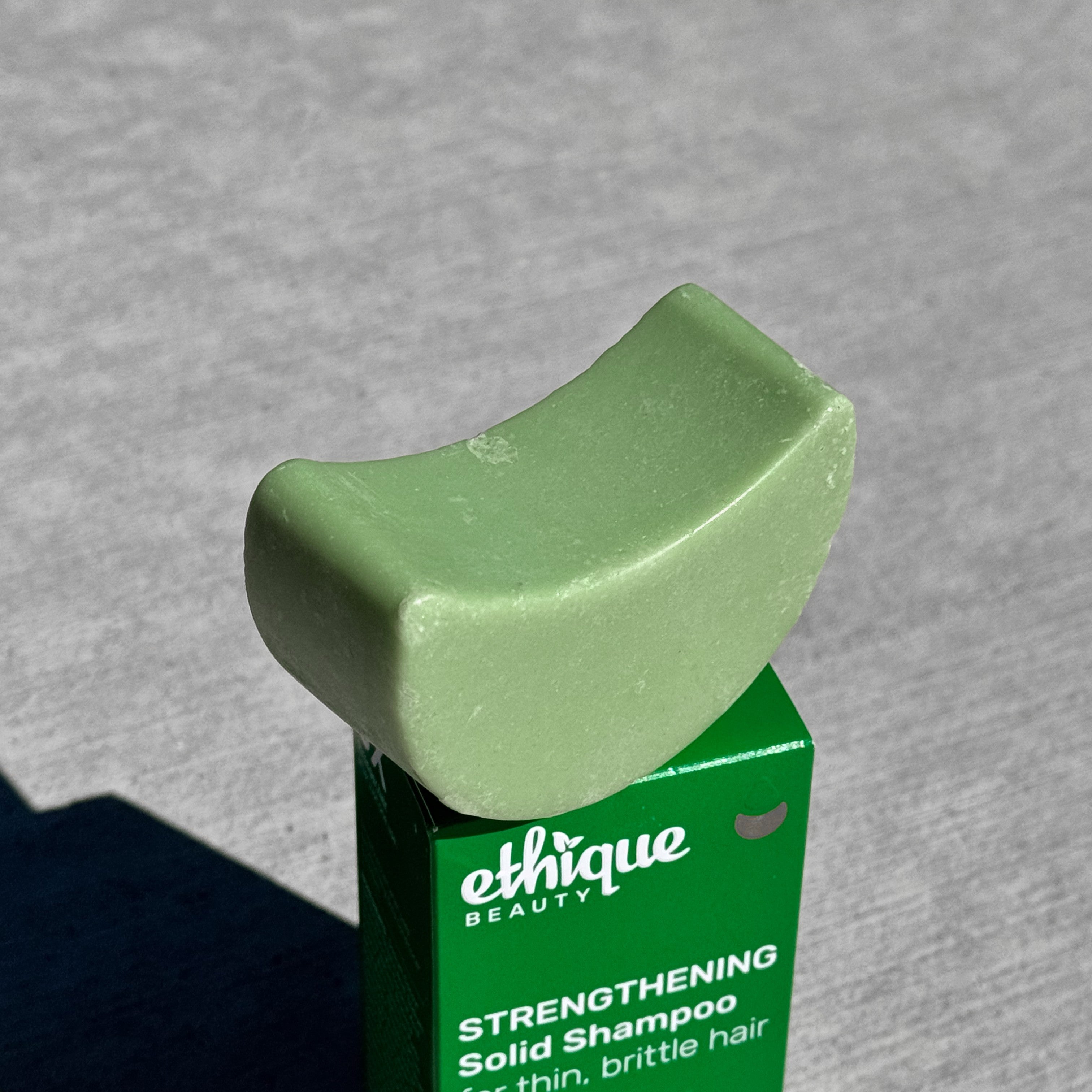
Ethique's STRENGTHENING Solid Shampoo is formulated for hair that breaks. The formula combines rosemary extract to stimulate scalp circulation and support follicle health, biotin to support keratin production, hydrolyzed quinoa containing all nine essential amino acids to repair damage from within, and peppermint oil to increase blood flow at the scalp. Clinical testing shows it delivers 3X stronger hair after just one use and decreases breakage by 70%.

For the full breakdown of what works, what doesn't, and how to build a routine around it, see our complete guide to how to get thicker hair.
If it's fine hair, not thinning
Different path entirely. You don't need follicle support - your follicles are doing their job. You need volume that doesn't weigh hair down.
Our VOLUMISING Solid Shampoo and Conditioner use caffeine for root lift, biotin to support the appearance of thicker strands, and epsom salt for texture and body. Lightweight formulas that add volume without residue. Clinical testing shows up to 10x more concentrated actives than typical liquid shampoo - more lift, no heaviness.

The full diagnostic and product breakdown is in our fine hair vs thin hair guide.
If it's temporary shedding
Address the trigger if you can identify it. Manage stress, recover from illness, restore nutrition if you've been crash dieting. Be patient - the hair growth cycle means six to nine months before you see significant improvement.
While you wait, support your scalp environment and protect the hair you have. Gentle handling matters. Good nutrition matters. Our STRENGTHENING formula can support new growth as it comes in.
If it's pattern loss or a medical condition
See a dermatologist for proper diagnosis and treatment options. Products can support overall hair health, but they won't reverse genetic hair loss or autoimmune conditions on their own. The combination of medical treatment and good hair care often produces the best results.
Quick reference: which is it?
|
Shedding |
Hair Loss |
Breakage |
|
|
Where |
At the follicle |
At the follicle |
Along the hair shaft |
|
What you see |
White bulb on fallen hairs |
White bulb, pattern or patches |
Blunt/ragged ends, no bulb |
|
Reversible? |
Usually yes |
Depends on type |
Yes |
|
Timeline |
Often sudden onset |
Usually gradual |
Correlates with damage |
|
Fix |
Address trigger, wait |
Medical if needed |
Reduce damage, strengthen |
Common questions about hair thinning, loss, and breakage
How much hair shedding is normal?
Fifty to 100 hairs per day is typical. You'll notice more during washing and brushing - that's when loose hairs get dislodged. If you're consistently finding more than that, or noticing clumps coming out, that's excessive shedding worth investigating.
Can stress cause hair loss?
Stress typically causes telogen effluvium - excessive shedding that starts two to three months after a stressful event. It's usually temporary and resolves once the trigger passes, though recovery takes another six to nine months. Chronic stress can affect overall hair health, but doesn't usually cause permanent hair loss on its own.
Will my hair grow back after breakage?
Yes. With breakage, your follicles are healthy - they're still producing new hair. Once you reduce the damage sources and support your hair with strengthening products, new growth comes in healthier. The already-broken sections need to grow out, which takes time.
How do I know if I need to see a doctor?
See a dermatologist if you notice sudden rapid loss, bald patches, scalp pain or inflammation, progressive pattern thinning, or hair loss accompanied by other symptoms like fatigue or weight changes. When in doubt, get it checked. Earlier intervention usually means better outcomes.
Sources
1. American Academy of Dermatology Association. Hair Loss: Diagnosis and Treatment.
2. Malkud S. Telogen Effluvium: A Review. J Clin Diagn Res. 2015;9(9):WE01-WE03. PubMed
3. Ho CH, Sood T, Zito PM. Androgenetic Alopecia. StatPearls. 2023. PubMed
4. Gilhar A, Etzioni A, Paus R. Alopecia areata. N Engl J Med. 2012;366(16):1515-1525. NEJM
5. Trüeb RM. Oxidative stress in ageing of hair. Int J Trichology. 2009;1(1):6-14. PubMed
This article is for educational purposes and does not constitute medical advice. Consult a healthcare provider for concerns about hair loss or scalp conditions.